By Marisse T. Sonido
Philippine Daily Inquirer
(Editor’s Note: The following is excerpted from the first-prize-winning essay in the PreMYo Rizal Nationwide Essay Writing Contest for high schools sponsored by Binhi English Literacy Foundation and MyRizal150. The author is a third-year student at Assumption Antipolo.)
Doctora Doña Victorina de los Reyes de Espadaña. Even her name has pomp and frills.
Meet Rizal’s effusive and self-proclaimed doña from “Noli Me Tangere”…
As amusing as I found her, I soon realized that her character had a greater purpose than to provide a satirical image of a vain woman. Like any character of Rizal’s, I realized she was meant to teach us something about our society … I understood how Rizal used Victorina (to show us) our own flaws…
From the very start, it was easy to see that Doña Victorina was all about appearances. She was described as wearing European dresses, her hair curly and her face heavily made up.
Her appearance was an indication not just of her shallow nature but also her obsession with prestige and admiration. It was perhaps this obsession that fueled her lifelong effort to pretend to be something she was not—a Spanish woman.
Filipino by birth, Doña Victorina abandoned her true identity to get to a higher place in life. A domineering person, she was committed to do anything to gain esteem, even pressuring her husband to improve their social standing by lying about his profession.
Victorina easily turned her back on her own people, caring nothing for the fact that she had become one of their abusers.
Feeling inferior
It was easy to see how Doña Victorina became the kind of person she was. She lived, after all, at a time when being an Indio made you automatically inferior to the Spanish colonizers. She saw that she would get none of the prestige she desired unless she became one of those who were on top.
Her way of seeing things was not something she could completely be blamed for. Almost everyone tried to do the same, as they saw how the Spaniards controlled every aspect of life and how they were prosperous as a nation.
Even Rizal acknowledged that Filipinos had much to learn from our colonizers.
Victorina, though, brought her obsession to the point where she rejected her heritage. This, Rizal showed us, was what really made Victorina corrupted: She knowingly turned her back on her country for her selfish ambitions.
Victorina, the consummate “social climber,” showed that people would do anything to get attention and respect. And people like her are still present today.
Doña Victorina contributed nothing to her society, just as the social climbers of today do nothing to help our society, as they step on each other to reach the highest pedestal.
I admit that, at some point in my life, I also worked to earn the approval of others to make me feel self-important. Rizal taught us, as we read about Victorina’s shallow desires, that there was a difference between appearing to be great and being truly great as a person, and that respect earned through petty, shallow means was not worth it. Esteem must be gained through sincerity, honesty and hard work.
Cosmetic change
Doña Victorina was a character who never seemed to find security in who she really was. Aside from denying her nationality, she covered herself in cosmetics and frills to improve the appearance she valued so greatly.
The “improvements” helped her mask her Filipino identity to assume a more Spanish-like appearance: pale skin and curly hair.
For her, these physical attributes represented her integration into Spanish society. Today’s Victorinas, dissatisfied with their true identities, adopt the traits most desired by the majority, or those they believe are superior to their own. Today, people use treatments like glutathione to whiten their skin, still believing that pale skin makes one more attractive. Often, people undergo procedures to make their hair straighter, curlier or even lighter in color.
Rizal said Doña Victorina was an example of how one could forget the value of nationalism…
Colonial mentality is something most of us have in common with the Filipinos of Rizal’s time, who were made to believe that they were inferior to those who ruled over them.
In attaching a sense of inferiority to the word “Filipino,” we destroy our own opportunities for growth by assuming we can never be greater as a nation.
Pride in who we are
In his time, Rizal saw this notion of inferiority as a hindrance to achieving our full potential as a nation. Through Victorina, he wanted to show Filipinos that the only way they could rise above oppression was to embrace their national identity.
Rizal also showed us we would remain enslaved by our country’s present problems and our colonial mentality if we could not find enough pride and love to make the Philippines a better place.
Through Victorina, Rizal asked us all a crucial question: If even we cannot stay in our own country and work for its growth, who else will bother to make the difference?
In Doña Victorina’s greed and superficiality, I learned the harm that yearning for undeserved respect could bring to me and everyone around me. I realized I should concentrate on doing what I could for my community, instead of what I could gain. Most importantly, through Doña Victorina’s colonial mentality, I learned what nationalism really meant.
It meant embracing your country’s flaws to be able to work towards progress and growth; to see that there was something better out there and, using that knowledge, helping your country instead of giving up on it.
Rizal showed me that I, too, could help make the Philippines greater, even if it was just by studying well and equipping myself with knowledge I could use to help my country in the future.
I am glad Doña Victorina caught my interest so strongly. In the story of a Filipino woman who held no love for her country, Rizal renewed my sense of nationalism and armed me with knowledge and insight Doña Victorina would never gain.
Rizal inspired me with his novel to be proud of the heritage Victorina denied and to make myself a better person by becoming a better Filipino.
Disclaimer:This is a repost. To view the original article, click here.
Monday, January 30, 2012
Wednesday, January 25, 2012
Luneta: A Place of Commerce
Written by

Rizal Park (Luneta) is not only a place of historical significance, or a shrine to view and appreciate, but also an avenue of commerce and entertainment. Here are some of the things people can buy at very reasonable prices. Click on the images for an enlarged view.


For more pictures, visit the Photo Gallery.
A Virtual Tour of Rizal Park
Written by

For people living a great distance from the country's capital, probably the only view that comes to mind at the mention of the Luneta (Rizal Park) is the monument. This is probably because the monument is the single most photographed portion of the entire vicinity. Here's a virtual tour of Rizal Park, the way the Manileños enjoy it. Click on the images for an enlarged view.
Upon entering the park, a welcome message reads: Mabuhay! Welcome to Rizal Park, the Philippines' premier National Park. Named after our great national hero Dr. Jose P. Rizal, it is a showcase of our country's heritage and culture. Rizal park is also the Kilometer Zero to the best of the Philippine Islands and destinations. Rizal park is our park - your park. Help us in maintaining the cleanliness and beauty of its surroundings and in promoting security, peace and order for a truly enjoyable stay. Maraming salamat po!
For what it's worth, the entire area IS clean, sweepers see to it that the pavement is free of litter, which can be conveniently thrown in trash bins located all over the place every five meters or so. Security is also tight, and guards constantly do a visual sweep of the place, patrolling the grounds in their bicycles.
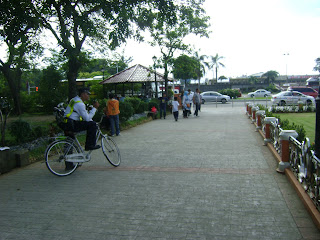
A security guard, on the aforementioned bicycle.

This is the Vicinity Map of Rizal Park. From this view alone, it is apparent that there's more to this place than just the monument.

This is a wide view of the Luneta. If inspected very closely, this photograph shows the Rizal monument a long distance away, situated to the right of the long-range view of the Philippine flag.

These intricate landscaping designs and cultural works of art can be found all over the park.

Along the length of the Luneta are busts of Filipino heroes, men and women who have made a mark in the country's history. This photograph shows only one of two parallel rows of sculptures. For an individual view of the busts, click here.

At the center of the park is located the dancing fountains. These splendid mechanisms show a colorful display of water and lights and music every night. To see what the show looks like in the evening, click here.


Yes, that's a train. Similar to the ones seen in big malls all over the country that take people on a tour around the area, this train takes visitors on a guided trip around the park -- for a modest fee, of course.

Unlike the traditional kalesa, this one is made from metal frames and rubber wheels and has the American flag painted all over the back seat. There can be much speculation about the rationale behind the designing of this transport vehicle in relation to it being in the National Park, but then again its origin could simply be traced to the eager desire of certain high-ranking people to attract tourists -- give them something familiar in a foreign land to ride on, with a subtle blend of the local culture.

This one is a more native version of the Philippine kalesa, although it still does have a touch of modernity to it. Along the sides are pictures relating to the national hero, Rizal, and places all over the country where structures and monuments built in his honor can be found.

Along the path leading to the Rizal monument are engraved quotations by the national hero. This one reads, "Ibig koy lagi nang makarinig ng pintas sa akin, pagka't nakukuhang pabutihin nito ang mga may hangad magpakabuti," which, in English, translates "I delight in hearing other people criticize me, because reprobation emboldens anyone who wishes to change, to change for the better."
THE RIZAL MONUMENT
Here are shots of the world-famous Rizal monument, which is not only a reminder of Jose Rizal's heroism, but also his final resting place. For more information on the Rizal Monument, click here.


For more images, visit the Photo Gallery.
Sunday, January 22, 2012
Busts of Heroes at Rizal Park
Written by

Two long columns of Filipino heroes run the length of Rizal Park. Here are a few of them. Click on the image captions for an enlarged view:
|
| Apolinario Mabini |
Overcoming extreme poverty and a crippling paralysis, he became known as the Brain of the Philippine Revolution. He was one of the chief advisers of President Emilio Aguinaldo and served as a foreign minister and President of the cabinet. He staunchly stood for Philippine independence and was exiled to Guam for his refusal to swear allegiance to the United States.
 |
| Datu Ache |
A Tausug chieftain, who commanded Sultan Bongsu's force of warriors in repelling an armada of 80 ships with 600 Spaniards and 3,000 Christian Filipino allies led by Governor Sebastian Hurtado de Corcuera on January 4, 1638.
 |
| Datu Taupan |
Also known as Panglima Taupan, he was the leader of the Sama Balanguigui of Zamobanga, Basilan and Tonquil islands. He fought for the independence of his people against Spanish incursions and launched raids against Spanish settlements. In 1848, Spanish forces using modern gunboats finally took Balanguigui Islands after a fierce battle. Datu Taupan and his followers were captured and were relocated to Isabela province in Northern Luzon.
 |
| Diego Silang |
Working as a mail courier between Manila and Vigan, Ilocos Sur, he was witness to the excesses of the Spaniards. During the British Invasion of Manila, he urged his provincemates to arm themselves against the British and at the same time demanded the abolition of forced labor and tribute. His actions were misinterpreted as rebellion and he was imprisoned. Upon his release he led a revolt which spread to Pangasinan and Cagayan. He also allied himself with the British to gain diplomatic support. Fearing his growing power, the Spaniards had him treacherously assassinated by his friend Miguel Vicos on May 28, 1763.
 |
| Francisco Dagohoy |
Enraged by the refusal of a Spanish friar to bury his brother, he led a rebellion against Spanish rule which lasted from 1744 to 1829. The rebellion which was also fueled by excesses of the Spanish authorities lasted for more than 80 years, the longest in Philippine history.
 |
| Francisco Maniago |
A leader of the village in Mexico, Pampanga, who led a revolt in protest against forced labor and confiscation of rice by the Spaniards. He blocked the mouths of the rivers of Pampanga to stop commerce with Manila. His rebellion ended with the acceptance of his demands by the Spaniards.
 |
| Graciano Lopez Jaena |
A fiery writer and orator, he was one of the Filipino propagandists seeking reforms for the Philippines. He founded and became the first editor of the newspaper La Solidaridad which became the organ of the reform movement in Spain.
 |
| Jose Ma. Panganiban |
Known as the defender of Filipino honor, he was one of the most eloquent writers of the propaganda paper, La Solidaridad. An energetic orator, he championed the freedom of the press and advocated the improvement of the educational system of the Philippine colony.
 |
| Lapu-Lapu |
The chieftain of the small island of Mactan. On April 27, 1521, with a force of more than 1,000 followers, Lapu-Lapu defeated Magellan, killing him. His victory over the Spaniards delayed the colonization of the Philippines until 1565.
 |
| Mateo Carino |
The Ibaloi Chieftain of Benguet who led a successful revolt against the Spanish garrison in La Trinidad in 1898. Aguinaldo made him "captain" of Baguio and head of the Igorot army.
Saturday, January 21, 2012
The Truth About the Rizal Monument
Written by

By Ronald S. Lim
NOT ONLY is the Rizal Monument a reminder of Rizal's heroism — it also marks his final resting place.
MANILA, Philippines — the year draws to a close, so does the 150th birth anniversary celebrations of the country’s national hero, Dr. Jose Rizal.
One of the final activities commemorating Rizal’s birth sesquicentennial was Ambeth Ocampo’s lecture called “Doble Kara: Rizal in Art and Monument”. “Doble Kara” is Ocampo’s last lecture of the year, as well as the concluding installment in the “History Comes Alive!” series held at the Ayala Museum.
“Doble Kara” revisits the origins of the Rizal Monument in Luneta Park. From its origins in Switzerland, to the history of the land it stands on, Ocampo looks at the many strange ways that Rizal is represented in our art and history.
With more than a hundred monuments of the national hero to be found all over the country, there have been several representations of Rizal – from the usual depictions of him wearing his famous black overcoat, to the more unconventional ones to be found in the countryside.
“We have one in Binan, Laguna, that looks like a wedding cake. There’s an art deco one. Sometimes he’s all white, sometimes they give him a black coat. But the most amazing monument is the one in Catbalogan, where they have three nude men carrying him!” shares Ocampo with a laugh.
KILLING FIELDS
Ocampo began his lecture by tracing the history of the monument’s location – Rizal Park. Before becoming the park as we know it today, Rizal Park was the “killing fields” of the country’s Spanish colonizers.
“Its old name was really Bagumbayan. Spanish Manila was the area inside the walls of Intramuros. The area outside was new land, and that was why it was called Bagumbayan. It was formerly a place of execution,” he says.
Ocampo says that in much the same way that Rizal’s execution in Bagumbayan inspired people like Andres Bonifacio and Emilio Aguinaldo to begin the revolution, it was the execution of the priests Gomez, Burgos, and Zamora in Bagumbayan in 1872 that inspired Rizal and his contemporaries to dream of a better future for the country.
“Rizal said that if it were not for 1872, he would have been a Jesuit. There would have been no ‘Noli’, no ‘Fili’, and our history would have turned out a different way. Teodoro Agoncillo said that there is no Philippine history before 1872. He claimed that before that it was a history of Spain in the Philippines and not our history. 1872 is the base point for Philippine history,” explains Ocampo.
From that execution sprung an entire generation of heroes. At the time, Rizal was 11, Bonifacio was nine, Apolinario Mabini was eight, Antonio Luna was six, Emilio Aguinaldo was three, and Gregorio del Pilar and Emilio Jacinto were not even born.
PARK CUM CEMETERY
It was only during the American occupation, under the leadership of William Howard Taft, that Bagumbayan would begin to transform into what we know it today.
Playwright Pascual Poblete thought of the idea of constructing a monument for Rizal, and Taft provided land in the Luneta for the monument. Poblete, along with Rizal’s elder brother Paciano Rizal, and Juan Tuason among other, would solicit the money needed to build the monument.
Finding a sculptor to work on the monument involved a worldwide search and even some controversy. After choosing 30 works from those submitted around the world, the commission picked Italian Carlos Nicoli’s work – but never got around to building it.
“There are a lot of reasons for it. One was that he could not pay the bond. But if you look at his work, you could see that it was so complicated and too expensive to build. They gave it to the second prize winner who did ‘Guiding Star’, named Richard Kissling, best known for the Swiss monument of William Tell. The connection is that Rizal actually translated William Tell into Tagalog,” says Ocampo.
When construction on the monument began, the very first thing done was to transfer the remains of Rizal to its base. Rizal’s bones had been in the safekeeping of his family, who had unearthed it from where it was originally buried in Paco Park. Ocampo says that in effect, people are wandering around in a cemetery when they go to Rizal Park.
“It’s not a monument, he’s buried inside. When you have your pictures taken there, it’s a cemetery. It’s not really a park,” he says.
RIZAL’S WISHES
Even after its construction, the monument still courted controversy. When plans were made to modernize Rizal Park in the 1960s, future National Artist Juan Nakpil was tasked to modernize the monument in order for it to blend with the “future” Rizal Park.
“In 1961 they wanted to modernize the thing and they wanted to build a cultural complex in Rizal Park. It woUld have dwarfed the Rizal Monument, so they built a pylon that was made by future National Artist Juan Nakpil. It was another way of making the monument higher. What eventually happened was they put the pylon made of stainless steel, and people complained that it looked nightmarish,” shares Ocampo.
The pylon was eventually removed during the Holy Week, reportedly to prevent any court injunction from restraining them as government offices were closed during holidays. The pylon used to be located at the median of the Baclaran section of Roxas Boulevard.
But for all the time, money, and controversy that has gone into this most recognizable image of our national hero, what exactly was Rizal’s wishes after his death? This is where the ultimate irony lies, according to Ocampo.
“Rizal left specific instructions as to what to do when he was killed. ‘Bury me in the ground.’ He wanted to be buried in Paang Bundok, where Manila North Cemetery is. We buried him in Roxas Boulevard. He asked for a cross or a stone to be placed on his grave, we put tons of granite on top of him. He asked that we only put the date of his birth and the date of his death, we put a dedication to Rizal. He asked for no anniversaries, and yet we put wreaths. Why haven’t we followed him? That is because Rizal wrote a lot for a nation that did not read. I hope that we read him so that we can appreciate him and know what he really likes,” he says.
The Rizal monument tells us a lot about Rizal and a lot about ourselves, Ocampo adds.
"Your image of Rizal depends on the books you read, the teachers you had, and the monuments you saw. There will be more monuments as we have Rizals, and maybe in the multitude of Rizals that we have, maybe one day when we read him, we will find the real Rizal,” he ends.
Disclaimer: This is a repost. To view the original article, click here.
Rizal Park at Night
Written by

Here is a collection of photographs of Rizal Park taken at night. Click on the pictures for a larger view:
These busts of Filipino heroes runs along the length of the paved portion of the park.

With dancing fountains on display every night, Rizal Park is a favorite place to hang out and have fun at evenings.

Dancing fountains illuminate Luneta at night, and enliven the atmosphere with jovial music.

These dancing fountains run in sync with lights and popular music.

With artistic light displays, the expanding spray of water serves as a canvas on which moving images are projected.

The world-famous Rizal monument is also the place where Jose Rizal's remains lie

The Rizal monument, made grander with bright lights at night.

On each side of the Rizal Park, there are rows of food stalls and vendors that sell practically anything from food to souvenirs to photographs and playthings.
Saturday, January 14, 2012
Rizal Worship: The Rizalistas
Written by
The Rizalistas are a group of people who worship Jose Rizal, the national hero of the Philippines, as a divine being and deity. Similar to other religious groups, the Rizalistas have different sects whose beliefs may vary, but nonetheless share the same faith in Jose Rizal. These sects have different founders, founded on different dates, and are scattered in different parts of the archipelago. Some of the registered groups of Rizalistas today include:
- Espiritual Pilipino Catholic Church
- Samahan ng Tatlong Persona Solo Dios
- Iglesia Sagrada Filipina
- Ciudad Mistica de Dios
- Watawat ng Lahi
- Adamista
- Bathalismo
- And many others…
These individual sects each have their own chapters all over the country and even abroad. Some of them are found primarily in Laguna, in the town of Calamba, and in Quezon Province at the foot of Mount Banahaw.
Parallels: Jesus Christ and Jose Rizal
Rizalistas believe that there are apparent parallels in the lives and persons of both Jose Rizal, and Jesus Christ. Some of them even believe that Rizal was Christ himself, reincarnated. These parallel traits and characteristics include:
- Jose Rizal is the messiah of the Philippines, just as Jesus Christ is the messiah of Israel.
- Both Jesus Christ and Jose Rizal were good and upright men who pursued their ideals with purest methods and intentions.
- Both Jesus Christ and Jose Rizal were Asians.
- Both Jesus Christ and Jose Rizal were born into a country that was under colonial rule.
- Both Jesus Christ and Jose Rizal paid no attention to human differences in status, education, race, etc. and believed in equal and peaceful coexistence of all human beings.
- Both Jesus Christ and Jose Rizal were healers.
- Both Jesus Christ and Jose Rizal underwent mockery and trial for unjust charges.
- Both Jesus Christ and Jose Rizal were executed by their enemies.
- Both Jesus Christ and Jose Rizal died for what they believed in.

